Afterdrop Explained: The Science Behind Post-Swim Cooling
Last updated: January 2026
“I felt fine when I got out. Then ten minutes later, I was colder than I’d been in the water.”
If you’ve been cold water swimming, you’ve probably either said this yourself or heard someone else say it. Welcome to afterdrop—the phenomenon that confuses every new cold water swimmer and commands respect from even the most experienced Winter Warriors.
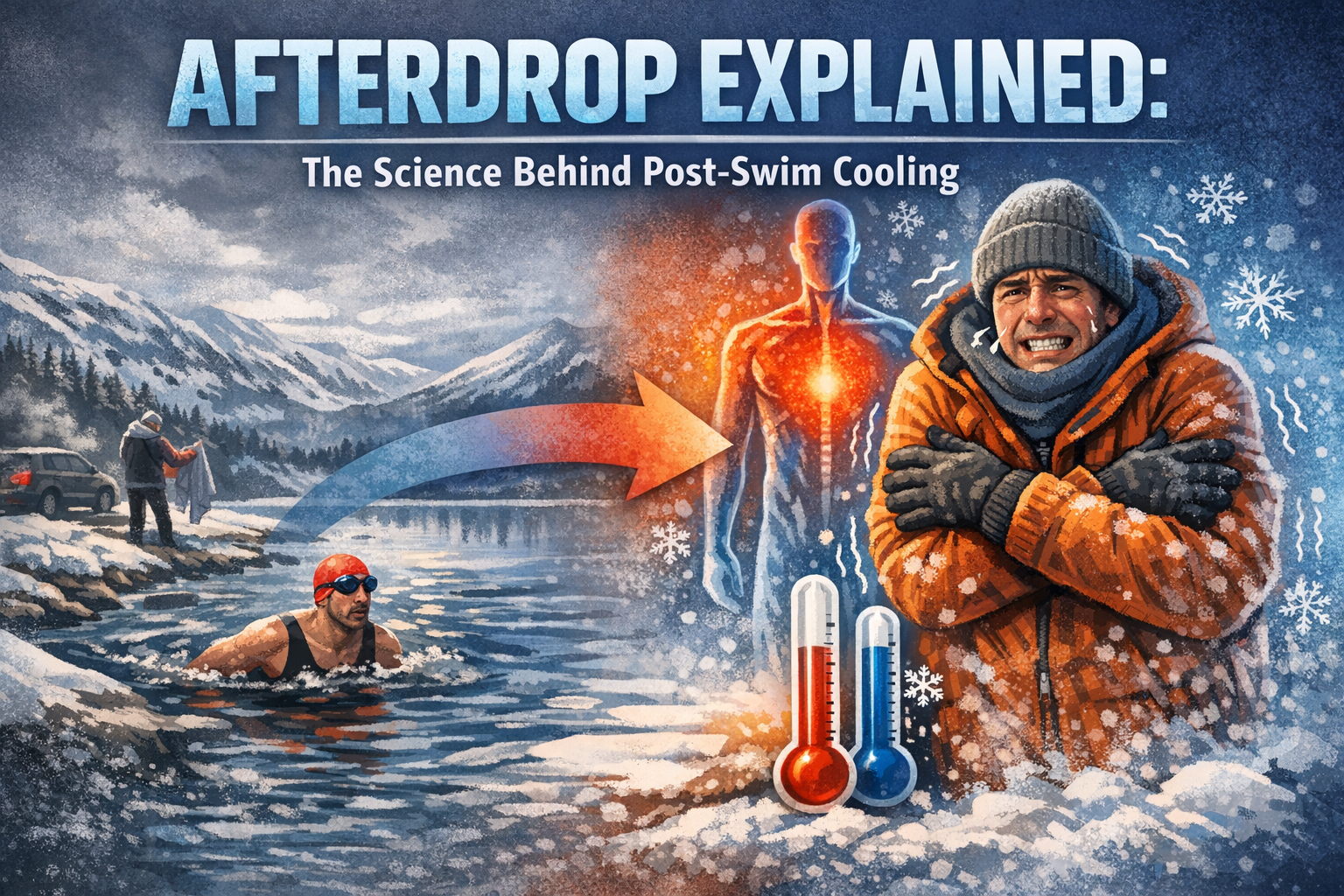
Afterdrop isn’t just “feeling a bit chilly after your swim.” It’s a genuine physiological process where your core body temperature continues to drop for 10-40 minutes after you’ve exited the water. In some cases, your core temperature can drop by an additional 1-3°C during this period, even though you’re out of the water, dried off, and dressed.
Understanding afterdrop isn’t just academic curiosity—it’s essential safety knowledge that determines whether you can swim confidently through winter or whether you’re one bad experience away from giving up cold water swimming entirely.
What Is Afterdrop? The Simple Explanation
Afterdrop is the continued cooling of your core body temperature after you exit cold water.
Here’s the paradox that confuses people: you’re out of the water, you’re dry, you’re dressed, you might even be in a warm car with the heater on—yet you’re getting colder, not warmer. Your body temperature is still dropping even though you’ve removed yourself from the cold environment.
The timeline:
- 0-5 minutes post-exit: You might feel fine, even slightly warm from the exertion of swimming
- 5-15 minutes post-exit: The cold hits. Shivering begins, intensifying rapidly
- 10-25 minutes post-exit: Peak coldness. This is when rigors (uncontrollable shaking) occur if they’re going to
- 20-40 minutes post-exit: Gradual warming begins. Shivering reduces. You start to feel human again
The severity and duration vary based on water temperature, swim duration, your body composition, fitness level, and acclimatization. But the phenomenon occurs to everyone who swims in water cold enough to trigger the physiological response.
The Science: Why Does Afterdrop Happen?
To understand afterdrop, you need to understand what happens to your body during cold water immersion.
During the Swim: Peripheral Vasoconstriction
When you enter cold water, your body immediately initiates a survival response called peripheral vasoconstriction. This is your body’s attempt to protect your vital organs.
What happens:
- Blood vessels in your skin and extremities constrict (narrow)
- Blood flow is redirected away from your arms, legs, and skin
- Warm blood is concentrated around your core and vital organs
- Your outer body (skin, muscles, extremities) becomes cold
- Your inner body (core, organs) stays relatively warm
This creates a temperature gradient: cold outer shell, warm inner core.
Imagine your body as a house in winter. You close off the unused rooms (extremities) and concentrate all the heating in the living area (core). The unused rooms get very cold, but the living area stays warm.
After Exiting: Peripheral Vasodilation
When you exit the water, your body begins the process of returning to normal circulation. Blood vessels that were constricted now dilate (widen) in a process called peripheral vasodilation.
What happens:
- Blood vessels in your extremities and skin begin to open up
- Cold blood from your outer body (which has been sitting in cold muscles and skin) starts flowing back toward your core
- This cold blood mixes with the warm blood in your core
- Your core temperature drops as cold blood returns to it
Back to the house analogy: you’ve opened the doors to those freezing cold rooms. The warm air from your living area rushes out to mix with the cold air from the unused rooms. Your nice warm living area suddenly gets a lot colder.
This is afterdrop. The cold that was stored in your outer body during the swim is now being transported to your core.
The Conduction Factor
There’s also a secondary mechanism at play: thermal conduction. Even after you’re out of the water, the cold “shell” of your body continues conducting cold inward toward your core, like a cold front moving through your body.
Research published in the Journal of Applied Physiology shows this conduction process can cause an additional 1-3°C drop in core temperature during the afterdrop period, even in controlled warm environments.
The Symptoms: What Afterdrop Feels Like
Afterdrop manifests differently in different people, but these are the most common experiences:
Mild Afterdrop
- Persistent shivering that won’t stop
- Feeling increasingly cold despite being out of water
- Cold hands and feet that seem to get worse before they get better
- Mild difficulty with fine motor tasks (fumbling with zippers, keys)
- Feeling “not quite right” but still functional
Moderate Afterdrop
- Violent shivering that’s difficult to control (“rigors”)
- Significant difficulty with coordination and dexterity
- Difficulty speaking clearly (slurred speech, stumbling over words)
- Strong desire to curl up and stop moving
- Feeling genuinely unwell
Severe Afterdrop (Medical Concern)
- Uncontrollable shaking that prevents any coordinated movement
- Confusion or altered mental state
- Inability to care for yourself (can’t dress, can’t operate car)
- Nausea or vomiting
- Feeling faint or dizzy
If you or someone else experiences severe afterdrop, this is a medical situation. Do not attempt to drive. Seek help immediately.
Risk Factors: Who Gets Afterdrop Worse?
Everyone experiences afterdrop to some degree in sufficiently cold water, but some factors make it worse:
Body Composition
- Lower body fat percentage: Less natural insulation means more rapid cooling and more severe afterdrop
- Smaller body mass: Smaller bodies have a higher surface-area-to-volume ratio, losing heat more quickly
Swimming Factors
- Longer immersion time: More time in cold water = more cooling of outer body = more severe afterdrop
- Colder water: Below 10°C is where afterdrop becomes significant; below 5°C is where it becomes potentially dangerous
- Higher exertion level: Harder swimming actually increases blood flow to extremities, which increases cooling
Individual Factors
- Poor acclimatization: First cold swims of the season are always worse
- Dehydration or low blood sugar: Impairs your body’s thermoregulation
- Previous cold exposure: Multiple swims in quick succession without full recovery increases afterdrop severity
- Age: Older swimmers often experience more severe afterdrop due to reduced circulation efficiency
The Danger: When Afterdrop Becomes Hypothermia
Here’s what makes afterdrop genuinely dangerous: if your core temperature drops low enough during afterdrop, you’ve crossed from “uncomfortable recovery” into “hypothermia.”
Hypothermia classifications:
- Mild hypothermia: Core temperature 35-36°C (95-96.8°F)
- Moderate hypothermia: Core temperature 32-35°C (89.6-95°F)
- Severe hypothermia: Core temperature below 32°C (89.6°F)
Most cold water swimmers will never experience moderate or severe hypothermia if they follow proper protocols. But mild hypothermia during afterdrop is more common than most people realize—especially in early season when acclimatization is poor.
Signs you’ve crossed into mild hypothermia:
- Persistent confusion or difficulty thinking clearly
- Loss of coordination that doesn’t improve
- Shivering that stops (paradoxically a bad sign—it means your body is running out of energy)
- Slurred speech that persists beyond 15-20 minutes
- Extreme fatigue and desire to sleep
Prevention Strategies: Managing Afterdrop Effectively
You cannot prevent afterdrop entirely—it’s a physiological response to cold water immersion. But you can significantly reduce its severity and duration.
Strategy 1: Limit Your Cold Exposure
The most effective prevention is to exit the water before you’re excessively cold. This requires self-awareness and discipline.
Guidelines:
- Exit before you feel cold in the water (you should feel “okay” when you exit, not “I’m getting cold”)
- Follow the 1-minute-per-degree rule: 10°C water = 10-minute max swim for unacclimatized swimmers
- Err on the side of caution early in the season
- Remember that feeling “fine” in the water doesn’t mean afterdrop won’t hit hard
Strategy 2: Rapid Insulation
The faster you get warm, dry layers on your body, the less severe your afterdrop will be.
Best practices:
- Have your clothing laid out and ready before your swim
- Dry roughly but quickly (don’t waste time being thorough)
- Prioritize getting layers on over being completely dry
- Focus on both upper AND lower body insulation—don’t neglect your legs
Key insight from research: Proper post-swim recovery clothing can reduce afterdrop severity by up to 60% compared to inadequate clothing. This isn’t just comfort—it’s safety.
Strategy 3: Fuel Your Body
Your body generates heat through thermogenesis, but this requires energy. Having adequate fuel makes a measurable difference.
Before swimming:
- Don’t swim on an empty stomach
- Have a light meal 1-2 hours before swimming
- Ensure you’re well-hydrated
After swimming:
- Consume warm, sugary drinks immediately (hot chocolate, sweet tea)
- Have a high-calorie snack available (flapjack, nuts, chocolate)
- The sugar provides quick energy for shivering thermogenesis
Strategy 4: Active Warming (Carefully)
Gentle movement helps, but be cautious about this.
Safe active warming:
- Gentle walking or marching in place
- Slow arm movements
- Light stretching
Dangerous “active warming”:
- Jumping jacks or vigorous exercise (increases blood flow to cold extremities, worsening afterdrop)
- Hot showers immediately post-swim (can cause peripheral vasodilation and worsen afterdrop)
- Alcohol consumption (impairs thermoregulation and is dangerous)
The mantra is: gentle movement, not vigorous exercise.
Strategy 5: Environmental Protection
Wind dramatically accelerates heat loss. Shelter makes a huge difference.
Best practices:
- Change in a sheltered location away from wind
- If using a car, get in it quickly once dressed
- Use windbreaks, trees, or buildings to block wind
- Consider a changing tent for particularly exposed locations
Recovery Protocol: What to Do When Afterdrop Hits
Even with perfect prevention, you’ll still experience some degree of afterdrop. Here’s how to manage it:
Immediate Actions (0-5 minutes post-exit)
- Exit water calmly and walk to your changing area
- Rough dry with towel (don’t be thorough, be quick)
- Put on dry base layer immediately
- Put on insulated trousers (like Cuddlr fleece-lined trousers)
- Put on thermal hat
- Get into changing robe or jacket
- Put on dry socks
Active Recovery Phase (5-20 minutes)
- Start drinking warm, sweet beverage
- Do gentle movement (walking, gentle arm swings)
- Stay in sheltered area
- Put on additional layers if available
- Monitor yourself for signs of confusion or severe symptoms
Stabilization Phase (20-40 minutes)
- Continue gentle movement until shivering subsides
- Finish warm drink
- Have a snack
- Ensure you’re mentally clear before considering driving
- Change into dry clothes if you’ve been wearing damp layers
Red Flags (Seek Help Immediately)
- Confusion that doesn’t improve
- Inability to care for yourself
- Shivering that becomes more severe rather than improving
- Feeling faint or dizzy
- Nausea or vomiting
Don’t tough it out. Severe afterdrop can progress to hypothermia, which is a medical emergency.
The Role of Acclimatization
Here’s the good news: your body adapts to cold exposure over time. Regular cold water swimmers experience less severe afterdrop than beginners swimming in the same conditions.
What happens with acclimatization:
- Your body becomes more efficient at peripheral vasoconstriction
- Your cardiovascular system adapts to manage the temperature shifts better
- Your shivering response becomes more effective
- Your psychological response to cold improves (less panic, better decision-making)
How to build acclimatization safely:
- Swim regularly (2-3 times per week minimum)
- Increase duration gradually
- Stay consistent through autumn into winter
- Don’t skip weeks—consistency is key
- Accept that early season swims will be harder
Acclimatization is the difference between surviving winter swimming and thriving in it. But it takes weeks to build and can be lost in just days of not swimming.
Common Myths About Afterdrop
Let’s dispel some dangerous misconceptions:
Myth 1: “A hot shower immediately after swimming will warm you up faster” Reality: A hot shower can worsen afterdrop by causing rapid peripheral vasodilation, rushing more cold blood to your core. Wait until shivering subsides before showering, and use warm (not hot) water.
Myth 2: “If you’re tough enough, you don’t need to worry about afterdrop” Reality: Afterdrop is physiological, not psychological. Mental toughness helps you manage the discomfort, but it doesn’t prevent the temperature drop. Some of the most experienced swimmers still get severe afterdrop in sufficiently cold conditions.
Myth 3: “Only weak swimmers get afterdrop” Reality: Swimming harder actually increases afterdrop severity by increasing blood flow to extremities. Elite swimmers experience afterdrop just like everyone else.
Myth 4: “You can train yourself to not shiver” Reality: Shivering is your body’s primary heat-generation mechanism. Suppressing it is dangerous. The goal is to reduce the severity of shivering, not eliminate it.
Myth 5: “Drinking alcohol warms you up” Reality: Alcohol impairs thermoregulation and creates a false sensation of warmth while actually increasing heat loss. Never drink alcohol before or immediately after cold water swimming.
Research and Resources
The scientific understanding of afterdrop has advanced significantly in recent years. Key research includes:
Golden & Tipton (1987) – “Human thermal responses during leg-only exercise in cold water” – Demonstrated that peripheral cooling continues to affect core temperature post-immersion
Giesbrecht et al. (1995) – “Cooling power of cold water immersions” – Quantified afterdrop magnitude in various conditions
Stocks et al. (2004) – “Optimum passive rewarming following cold water immersion” – Showed proper insulation reduces afterdrop by 60%
For swimmers wanting to dive deeper into the science, the International Journal of Circumpolar Health has published extensively on cold water immersion and recovery.
Personal Experience: Learning to Respect Afterdrop
I learned about afterdrop the hard way. Second year of open water swimming, December, overconfident from a good summer season. 20-minute swim in 4°C water. Felt strong during the swim. Got out feeling fine.
Then it hit.
Within 8 minutes, I was shaking so hard I couldn’t hold my car keys. My speech slurred. My friend asked if I was okay and I couldn’t form a coherent answer. I sat in my car for 35 minutes with the heater blasting before I felt functional enough to drive.
That experience taught me that afterdrop doesn’t care about your confidence, your fitness level, or your enthusiasm. It’s pure physiology, and it demands respect.
Since then, I’ve overhauled my recovery protocol. I limit my swims more conservatively. I invested in proper recovery gear—especially fleece-lined trousers that address the lower body cooling I’d been neglecting. I have a methodical changing routine. I monitor myself and my swimming mates for signs of trouble.
I still get afterdrop on every winter swim. But now I manage it safely. I know what to expect, I have the right gear, and I understand the science behind what my body is experiencing.
That knowledge transformed afterdrop from a frightening, miserable experience into a manageable part of the cold water swimming process.
Final Thoughts: Respect, Don’t Fear
Afterdrop isn’t something to fear—it’s something to respect and prepare for.
The cold water swimming community has a responsibility to educate newcomers about afterdrop. Too many people jump into winter swimming based on social media posts showing the “cold water high” without understanding the very real physiological challenges of the recovery period.
Understanding afterdrop is what separates sustainable winter swimming from one-and-done experiences. It’s the difference between swimmers who thrive through multiple winters versus those who have one scary experience and quit.
You don’t need to be fearless. You need to be informed, prepared, and respectful of what your body experiences during cold water recovery.
Get the right recovery gear. Learn your personal response to afterdrop. Build your protocols. Swim within your limits.
Then go experience the magic of cold water swimming with the confidence that comes from understanding exactly what your body is doing and how to support it through the recovery process.
The water is cold, but the rewards are worth it—as long as you respect the afterdrop.
—Written by a Lake District swimmer who learned these lessons through experience, research, and a few too many uncomfortable recovery periods
