Last updated: January 2026
“Bioprene is the next big thing in celebrity diets. Just you wait.”
This tongue-in-cheek joke from the open water swimming community refers to body fat—nature’s own insulation against cold water. It’s a humorous way swimmers talk about the very real physiological advantage that body composition provides in cold water.
But here’s what’s interesting: while bioprene (body fat) provides some protection, your body’s adaptation to cold water goes far beyond simple insulation. Understanding how your body actually adapts to repeated cold exposure—and how that differs from just wearing a wetsuit—is key to becoming a confident winter swimmer.
What Is Bioprene?
Bioprene is the swimming community’s playful term for subcutaneous body fat—the layer of fat beneath your skin that provides natural insulation.
The science: Fat conducts heat 3-4 times slower than muscle tissue. Swimmers with higher body fat percentages lose heat more slowly in cold water and can swim longer before experiencing hypothermia.
Real-world impact: A swimmer with 25% body fat might comfortably swim for 15 minutes in 8°C water, while a lean swimmer at 12% body fat might only manage 8-10 minutes in the same conditions.
The community perspective: Unlike in many sports, the cold water swimming community celebrates all body types. That “extra” body fat isn’t a liability—it’s functional insulation that serves a genuine purpose.
Important caveat: Body fat provides passive insulation but doesn’t replace proper acclimatization, technique, or recovery protocols. A lean, well-acclimatized swimmer will outperform an unacclimatized swimmer with more body fat.
What Is Neoprene?
Neoprene is synthetic rubber foam used in wetsuits. It provides insulation by trapping a thin layer of water against your skin, which your body warms up.
How it works:
- Closed-cell foam structure traps air bubbles
- Creates barrier between your skin and cold water
- Allows thin layer of water to be warmed by body heat
- Thickness (3mm, 5mm, etc.) determines insulation level
Advantages of neoprene:
- Immediate insulation without acclimatization
- Allows longer swims in cold water
- Provides buoyancy
- Reduces cardiac stress from cold shock
Disadvantages:
- Prevents true cold adaptation
- Can create dependency
- Reduces sensory feedback about water temperature
- Expensive and requires maintenance
- Restricts natural swimming movement
The Wetsuit Debate in Cold Water Swimming
The UK cold water swimming community has complex feelings about wetsuits.
Wetsuit swimming is legitimate if:
- You’re training for triathlon or specific events requiring wetsuits
- You have medical conditions affected by cold
- You’re gradually working toward skins swimming
- You simply prefer swimming with added warmth and safety
The “skins” (non-wetsuit) perspective: Many dedicated cold water swimmers eventually transition away from wetsuits because:
- The sensory experience of cold water is part of the appeal
- True cold adaptation only occurs without neoprene barrier
- The challenge and achievement of skins swimming is rewarding
- Community status often favors skins swimmers (though this varies by group)
The honest truth: Neither approach is “wrong.” Some of the most experienced swimmers use wetsuits in winter. Others wouldn’t dream of it. Do what works for you.
Key principle: Don’t let anyone shame you for your choice. Swim your own swim.
How Cold Adaptation Actually Works
When you repeatedly expose yourself to cold water without a wetsuit, your body adapts in remarkable ways that go far beyond simple insulation.
Adaptation 1: Improved Cold Water Shock Response
What happens:
- Reduced gasping reflex upon entry
- Faster heart rate stabilization
- Less severe hyperventilation response
- Improved ability to control breathing
Timeline: Noticeable improvement after 6-8 cold water exposures over 2-3 weeks
Real benefit: You’re safer in the water because you maintain control during the critical first 3 minutes
Adaptation 2: More Efficient Peripheral Vasoconstriction
What happens:
- Blood vessels constrict more effectively to preserve core heat
- Your body becomes better at maintaining warm core with cold extremities
- Reduced heat loss through skin
Timeline: Develops over 4-6 weeks of regular cold exposure
Real benefit: You can swim longer in cold water before core temperature drops dangerously
Adaptation 3: Enhanced Thermogenesis
What happens:
- Your body becomes more efficient at generating heat through shivering
- Non-shivering thermogenesis improves (heat generation without shivering)
- Brown adipose tissue may increase (specialized fat that generates heat)
Timeline: Develops over 8-12 weeks of consistent cold exposure
Real benefit: Recovery is faster and less miserable because your body warms itself more effectively
Adaptation 4: Psychological Resilience
What happens:
- Reduced anxiety about cold exposure
- Better decision-making in cold conditions
- Improved ability to assess your own state
- Greater confidence in managing discomfort
Timeline: Varies widely, but noticeable after first winter season
Real benefit: You swim with confidence rather than fear, making you safer and more capable
The Acclimatization Process: Building Your Bioprene Response
True cold adaptation requires systematic, gradual exposure. You can’t rush it.
Optimal acclimatization protocol:
Stage 1: Late Summer/Early Autumn (15-18°C)
- Swim 2-3 times per week
- Duration: 20-30 minutes
- Goal: Establish baseline comfort in cool water
- Wetsuit: Optional, begin transitioning away if wearing one
Stage 2: Autumn (10-15°C)
- Maintain 2-3 swims per week minimum
- Duration: 15-25 minutes
- Goal: Build cold tolerance as temperature drops
- Wetsuit: Ideally removed by end of this stage
Stage 3: Early Winter (5-10°C)
- Continue 2-3 swims weekly (consistency is critical)
- Duration: 10-20 minutes
- Goal: Develop true winter swimming capability
- Wetsuit: Skins only at this point for full adaptation
Stage 4: Deep Winter (Below 5°C)
- Maintain consistency
- Duration: 5-15 minutes depending on conditions
- Goal: Sustain acclimatization through coldest period
- Wetsuit: Defeat the purpose of winter swimming if used now
Critical factors for success:
- Consistency is everything: Missing even one week sets you back
- Gradual progression: Water should only drop 1-2°C between swims
- No big jumps: Skipping from 12°C to 4°C will shock your system
- Listen to your body: Some days you need shorter swims
When Bioprene Helps (And When It Doesn’t)
Situations where body fat provides advantage:
- Long duration cold water swims (30+ minutes)
- Very cold water (below 5°C)
- Channel swimming or marathon swims
- Reducing rate of core temperature drop
Situations where body fat doesn’t help much:
- First 3 minutes (cold water shock affects everyone equally)
- Recovery/afterdrop (happens regardless of body fat)
- Swimming technique and efficiency
- Mental resilience to cold
The balanced perspective: Body fat is one factor among many. Technique, acclimatization, mental strength, and proper recovery protocols matter just as much or more.
Making the Wetsuit Decision
If you’re currently swimming in a wetsuit and considering transitioning to skins, here’s how to approach it:
Good reasons to transition away from wetsuit:
- You want to experience true cold adaptation
- You’re interested in the psychological challenge
- You want full sensory connection with water
- Community/events you want to participate in are skins-focused
Good reasons to keep wearing wetsuit:
- Medical conditions (Raynaud’s, heart conditions)
- You’re training for wetsuit-required events
- You simply prefer the added warmth and security
- You want to swim longer distances in cold water
Safe transition protocol:
- Start in warmer months (water 15°C+)
- Remove wetsuit for increasingly longer portions of swim
- Build up gradually from 5 minutes to full swim without wetsuit
- Don’t rush it—take an entire season if needed
- Accept that your swim duration will initially decrease significantly
Signs you’re not ready to transition yet:
- Experiencing severe cold water shock without wetsuit
- Unable to control breathing for several minutes after entry
- Extreme anxiety about swimming without wetsuit
- Haven’t established consistent swimming routine
There’s no shame in taking your time or deciding wetsuit swimming works better for you.
The “Toughness” Myth
Let’s address the elephant in the room: some swimmers treat skins swimming as a badge of toughness, looking down on wetsuit swimmers.
This is bullshit.
Swimming in cold water—with or without a wetsuit—requires courage, dedication, and mental strength. The choice of whether to wear neoprene doesn’t determine your worth as a swimmer.
What actually matters:
- Swimming safely within your limits
- Respecting the water and conditions
- Supporting other swimmers regardless of their choices
- Continuing to swim regularly despite difficulty
Red flags in swimming communities:
- Shaming people for wearing wetsuits
- Bragging about swim duration or water temperature tolerance
- Pressure to swim longer/colder than you’re comfortable with
- Dismissing safety concerns as “weakness”
Healthy swimming communities:
- Celebrate all swimmers regardless of wetsuit choice
- Prioritize safety over ego
- Support individual progression at personal pace
- Recognize that different goals require different approaches
Optimizing Your Natural Adaptation
Whether you swim skins or wetsuit, you can support your body’s adaptation:
Nutrition:
- Adequate caloric intake (your body needs energy for thermogenesis)
- Healthy fats support hormone production
- Protein for muscle recovery
- Stay hydrated (dehydration impairs thermoregulation)
Recovery:
- Proper post-swim warming protocols
- Adequate rest between swims (2-3 times per week is optimal)
- Quality sleep (adaptation happens during recovery)
- Manage stress (chronic stress impairs adaptation)
Training:
- Consistent swimming schedule (don’t skip weeks)
- Gradual progression in cold exposure
- Mix swim durations (some short, some longer)
- Include warm water swims for technique work
Lifestyle:
- Cold showers at home (some swimmers swear by this)
- Outdoor time in cold weather (year-round cold exposure)
- Maintain fitness (cardiovascular health supports cold adaptation)
Final Thoughts: Your Body, Your Choice
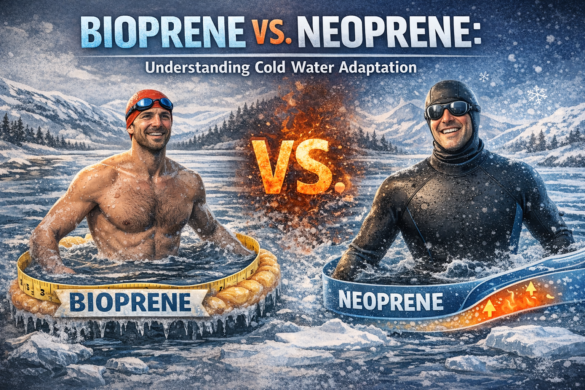
The bioprene vs. neoprene question is ultimately personal.
Some swimmers thrive on the challenge of skins swimming and the genuine cold adaptation it brings. Others prefer the security and longer swim duration that wetsuits provide. Both approaches have merit.
What matters is that you:
- Understand how cold adaptation actually works
- Make informed choices about your swimming
- Respect others’ choices even if different from yours
- Prioritize safety and sustainability over ego
Your body’s response to cold is unique. Your goals are your own. Your swimming journey is yours alone.
Whether you’re building bioprene through dedication to skins swimming or enjoying the water in neoprene, you’re part of the same cold water swimming community.
See you in the water—however you choose to swim.
—Written by a swimmer who spent two years in a wetsuit, transitioned to skins, and learned that both approaches are valid
